Consulting Room & Treatment Area Cleaning
The consulting room is where clinical contact happens — and where contamination travels in two directions. The patient brings pathogens to your surfaces. Your clinician picks them up and transfers them to the next patient. End-of-day cleaning plus the right between-patient protocol is the only way to break that cycle. Here's how we do it.
Why Consulting Room Contamination Travels in Both Directions
Every other area of a medical practice has a one-directional contamination pattern. In the waiting room, patients bring pathogens in and deposit them on surfaces. In the admin office, staff carry contamination from the clinical areas to the admin surfaces. The consulting room is different — it has a bidirectional contamination cycle that makes it the most infection-sensitive area in a typical GP or specialist practice.
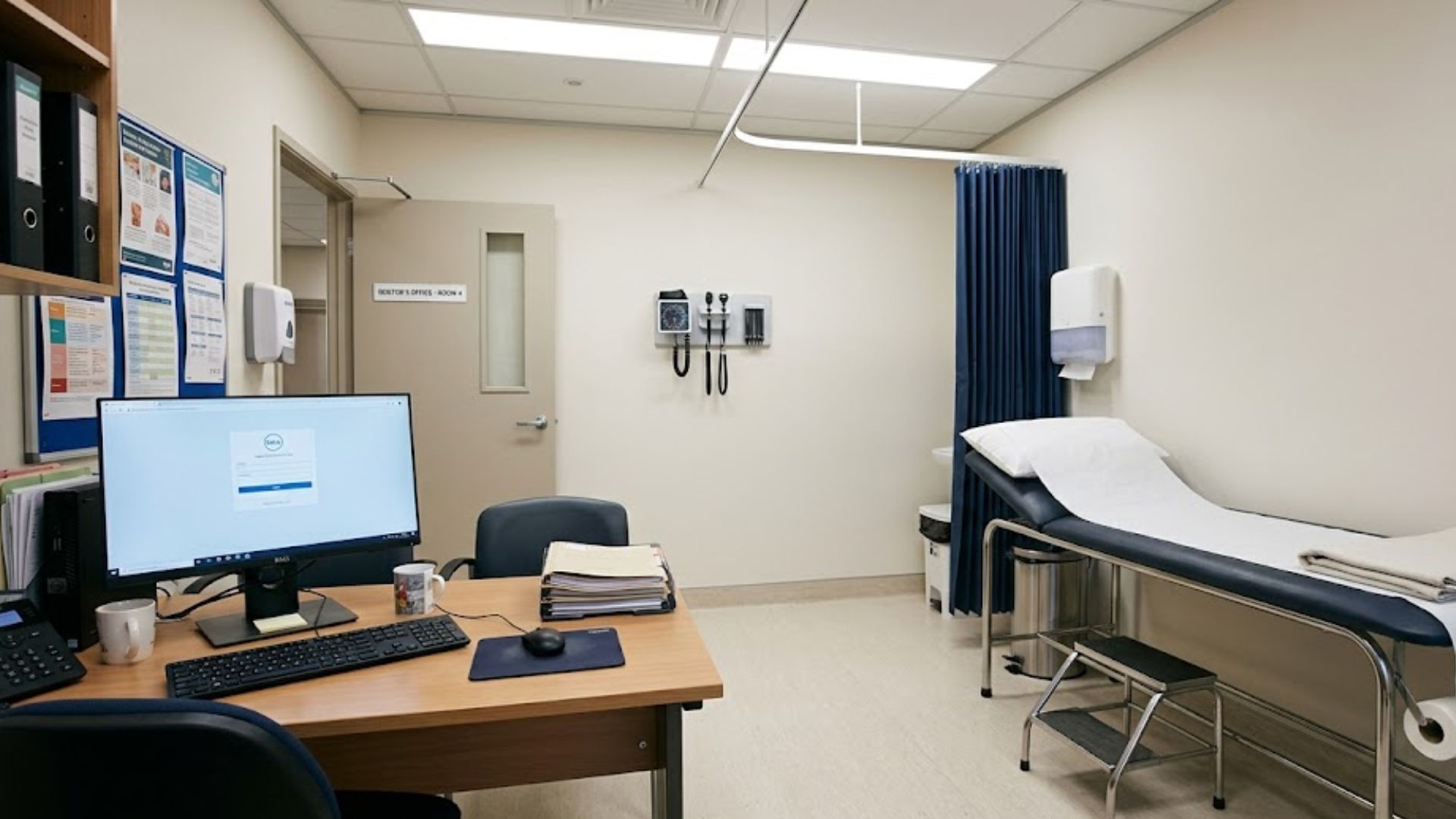
The patient enters and deposits their contamination on the entry handle, the chair, and the examination couch. The clinician conducts the examination, touches the patient and the patient's clothing, then returns to the desk — and immediately touches the keyboard to type clinical notes. That keyboard is now contaminated with whatever the patient brought into the room. The next patient sits in the same chair, lies on the same couch surface (even with paper roll — contamination wicks through), and at the end of the consultation, the clinician touches the same keyboard again before moving to the next room.
The diagram below maps the contamination flow in a standard consulting room. The surfaces in the middle column are the critical junction points — touched by both patients and clinicians in the course of every consultation.
What Our Consulting Room Cleaning Covers
Consulting room cleaning has two distinct components: the end-of-day nightly clean that resets the full room, and the between-patient protocol that your clinical staff manage during operating hours for the highest-risk surfaces. Both are necessary — neither replaces the other.
The nightly clean is the comprehensive reset: every surface in the room is disinfected, floors are mopped, clinical waste is checked, the couch is disinfected along its full length, the paper roll is replaced if low, curtains are checked, and a signed compliance record is produced. This is what we do after every clinical day.
The between-patient protocol covers the surfaces that cannot wait until the end of the day because they're touched by every patient who walks through the door. The examination couch — even with a paper roll — requires a wipe-down between patients if there has been any direct body contact below the paper or any visible soiling. The keyboard, the chair armrests and the door handle are the other surfaces that need to be addressed between patients if your practice is following a robust infection control protocol. We provide a written between-patient protocol checklist as part of our service onboarding, so your clinical staff know exactly what they're responsible for during the day.
The examination couch and the paper roll is worth addressing specifically because it's the most misunderstood surface in a consulting room. The disposable paper roll protects the couch surface from soiling, but it does not make the couch surface clean — it makes the soiling invisible. Contamination wicks through paper roll under body weight and warmth. The vinyl couch surface beneath needs to be disinfected with a vinyl-safe TGA product at regular intervals regardless of paper roll use, and the paper roll itself should be advanced between every patient.
Every Zone, Nightly
Two Cleaning Layers — Why Both Are Non-Negotiable
Consulting room infection control has two separate timing layers. Conflating them — or relying on one to cover both — is how cross-contamination occurs between patients during the day. The nightly clean cannot undo contamination that transferred between patients at 10am and 2pm. Between-patient controls cannot replace the comprehensive end-of-day disinfection of every surface. Here's what each layer covers.
These surfaces are touched by every patient and/or by the clinician immediately after clinical contact. They cannot accumulate contamination from multiple patients across a session.
This is clinical staff responsibility during operating hours. We provide a between-patient protocol reference sheet as part of our service onboarding.
At end-of-day, the room receives a comprehensive reset that the between-patient protocol cannot achieve — full surface coverage, correct product, correct dwell time, and documented compliance.
Why One Product Can't Cover Every Surface in a Consulting Room
The consulting room has a wider surface material variety than almost any other room in a medical practice. The examination couch vinyl requires a QAC-based disinfectant — alcohol degrades vinyl over time, causing micro-cracking that creates surfaces impossible to clean properly. The keyboard and electronic equipment cannot tolerate sprayed liquids of any kind. The floor needs a diluted disinfectant product appropriate for the floor surface. The curtain leading edge can tolerate a higher-concentration disinfectant wipe than the vinyl couch can.
Using a single product — typically an alcohol spray — on all of these surfaces is the default approach in many commercial and even some healthcare cleaning operations. It damages the vinyl, leaves a residue on electronics, and is often used at too short a contact time to actually disinfect rather than just wet. Correct product selection for each surface, at the correct dilution, with the correct contact time, is what separates a disinfection service from a surface wipe service.
All products we use in consulting rooms are TGA-registered for use as surface disinfectants in healthcare environments. Where a surface has a manufacturer-specified incompatible chemical category, we use a compatible alternative that still achieves TGA-standard disinfection — we never substitute an unregistered product to avoid incompatibility.
What We Use — and Where
| Surface | Product Type | Why |
|---|---|---|
| Examination couch vinyl | QAC disinfectant — alcohol-free | Alcohol degrades vinyl; QAC achieves full disinfection without material damage |
| Keyboard & mouse | Dampened anti-static microfibre — no spray | Prevents liquid ingress; anti-static cloth safe on all keyboard materials |
| Monitor screen | Dry anti-static cloth only | Any moisture on screens causes delamination of anti-glare coating over time |
| Hard desk surface, handles, switches | TGA-registered QAC spray | Standard hard surface disinfection — correct dwell time observed |
| Equipment tray & trolley | TGA-registered QAC or 70% IPA wipe | Stainless or powder-coated steel tolerates either; IPA used where faster dry needed |
| Curtain leading edge | TGA-registered disinfectant wipe | Fabric-tolerated concentration; leading edge only — not full curtain body nightly |
| Hard floor | TGA floor disinfectant — diluted per label | Over-concentration on vinyl or tile floors leaves residue; correct dilution essential |
← Swipe table to see all columns on mobile
Consulting Room Cleaning Cost in Melbourne
Consulting room cleaning is priced per room based on the number of consulting rooms in your practice, whether treatment procedure rooms are included, and whether the service covers clinical rooms only or the full premises including reception and administration areas. All prices below are indicative guide prices excluding GST.
Most Melbourne practices find it significantly more cost-effective to have the full premises — consulting rooms, waiting room, admin and bathrooms — cleaned under a single service contract rather than clinical rooms only. This removes the coordination overhead and ensures consistent documentation across the full practice.
The between-patient protocol reference sheet, compliance record template and service specification are all included at no additional cost when you onboard with us. Your written quote is produced within 24 hours of a free site walkthrough. See our pricing page for full detail on how medical practice cleaning is priced in Melbourne.
Consulting Room Clean Cost Guide
Consulting Room & Treatment Area Cleaning — Frequently Asked Questions
Questions from practice managers and GPs about consulting room and treatment area cleaning in Melbourne healthcare facilities.
No — and this is one of the most common misconceptions in consulting room infection control. The paper roll protects the vinyl surface from visible soiling and is an important hygiene measure, but it does not create a barrier to pathogen transfer. Under body weight and warmth, contamination wicks through disposable paper. The vinyl couch surface accumulates contamination over a clinical day regardless of paper roll use. The paper roll should be advanced between every patient to present a fresh surface, but the vinyl underneath still requires regular disinfection — nightly at minimum, and whenever there is visible soiling or suspected body fluid contact through or around the roll.
Alcohol — specifically isopropyl alcohol (IPA) at concentrations above about 30% — degrades the plasticisers in vinyl over time. This causes the vinyl surface to dry out, micro-crack, and eventually become porous and discoloured. A micro-cracked vinyl surface is functionally impossible to disinfect properly because pathogens shelter in the cracks and cannot be reached by a surface wipe. The couch also becomes uncomfortable for patients and presents a clinical infection control failure. Vinyl-safe quaternary ammonium compound (QAC) disinfectants achieve the same or better efficacy against healthcare-relevant organisms without the material degradation. We never use high-concentration alcohol products on vinyl couches.
We clean the top and side surfaces of each key, the spaces between keys, and the keyboard body — all with a dampened anti-static microfibre cloth wrung to near-dry. We do not spray liquid directly onto the keyboard at any point. The damp cloth technique allows us to clean into the gaps between keys without saturating the keyboard housing. The most contaminated areas on a clinical keyboard are the spaces between the keys and the inner edges of the top keycap surfaces — these are addressed on every nightly service. If your practice uses keyboard covers, we clean the cover surfaces instead and note their presence on the service record.
Between-patient cleaning during operating hours is the responsibility of your clinical staff — this is a clinical workflow task, not a contracted cleaning task. We can't be present between every patient throughout the day. What we do is provide a written between-patient protocol reference sheet as part of our service onboarding — a clear, laminated single-page guide that outlines what the clinician or nurse should check and act on between each patient for the consulting room and treatment areas. Our nightly service is the end-of-day comprehensive clean that resets all surfaces for the following morning. The two layers are designed to work together.
Consulting room cleaning is priced per room per nightly visit. A single room typically costs $30–$55 per visit. For 2–5 rooms, the per-room rate falls to $25–$45. Practices with 6 or more rooms are at $20–$38 per room. Procedure and treatment rooms with extended scope (minor surgery, wound care, infusion) are priced at $45–$80 per room. The most cost-effective option for most practices is a full-premises service covering consulting rooms, waiting room, admin and bathrooms under a single contract — this is also the cleanest from a compliance documentation standpoint. Written quotes are produced within 24 hours of a free site walkthrough. See our pricing page for more detail.
Get a Consulting Room Cleaning Quote for Your Melbourne Practice
We walk through every consulting and treatment room, build a room-by-room specification with the correct product for each surface, and provide a written quote within 24 hours. Between-patient protocol sheet and compliance records included as standard. Call 0484 042 336 or request online.