
Infection Control Cleaning Melbourne
Infection control cleaning is the application of a defined, evidence-based protocol to reduce the transmission of pathogens in a healthcare environment. It is not the same as thorough cleaning. A thoroughly cleaned surface can still harbour viable pathogens if the correct disinfectant was not used, if the dwell time was not observed, or if the sequence of cleaning was wrong. Infection control cleaning is the sum of the correct method, the correct chemistry, the correct sequence and the trained person applying all three consistently — every time, not most of the time.
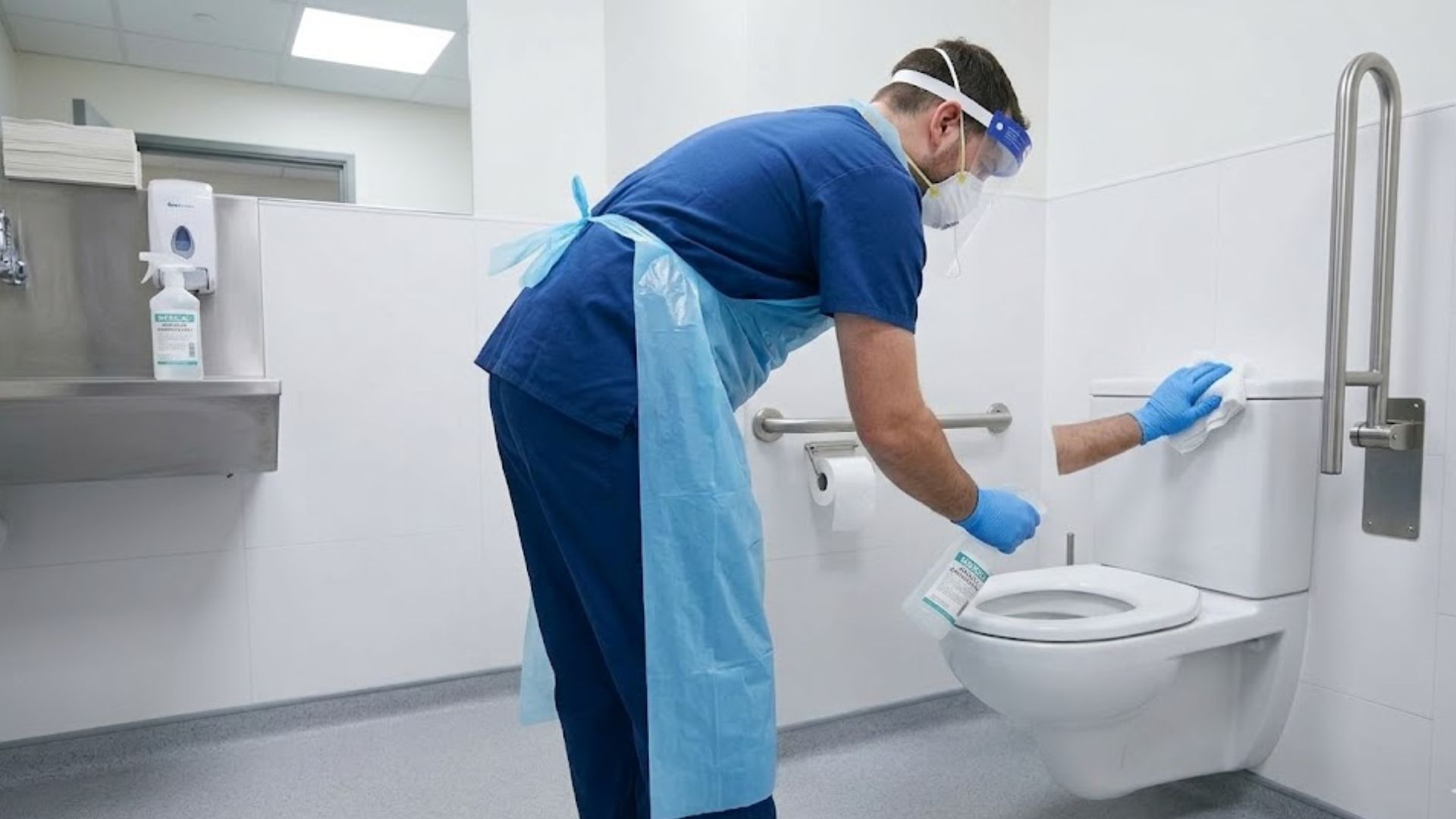
The Two-Step Clean-Then-Disinfect Protocol — Why the Sequence Is Not Optional
The most common infection control cleaning failure in healthcare facilities is not using the wrong disinfectant — it is applying disinfectant to a surface that has not been cleaned first. Organic matter on a surface — blood, mucus, body fluid, skin cell debris, food residue — physically inactivates most disinfectants on contact. A TGA-registered hospital-grade disinfectant applied directly to a visibly soiled surface achieves a fraction of its labelled kill claim. The two-step protocol resolves this: clean first to remove organic load, then disinfect the clean surface to the product's full kill specification. These are two distinct steps that cannot be combined into one, and the sequence cannot be reversed.
The cleaning step uses a neutral detergent — not a disinfectant — to physically remove organic matter, biofilm, dust, grease and visible soiling from the surface. A fresh single-use cloth or disposable wipe is used for each surface or zone.
Why neutral detergent and not disinfectant? Disinfectants are not effective cleaners — their chemistry is optimised for killing microorganisms on clean surfaces, not for emulsifying and removing organic soiling. Using a disinfectant as a combined cleaner-disinfectant results in a surface that is neither properly cleaned nor properly disinfected.
Colour-coded microfibre: Cleaning cloths are colour-coded by zone — one colour for clinical surfaces, a separate colour for bathroom areas, a separate colour for non-clinical areas. A cloth used in one zone is never reused in another. Each cloth is single-use per room in isolation-area cleaning.
Once the surface is visibly clean and free of organic load, a TGA-registered hospital-grade disinfectant is applied. The disinfectant must be left on the surface for the manufacturer-specified contact time — the dwell time — before it is wiped off or allowed to air-dry. Wiping off immediately defeats the kill mechanism entirely.
Product selection is based on the pathogen risk profile of the zone and the surface material. A quaternary ammonium compound (QAC) is appropriate for general clinical surfaces. A sporicidal product — typically a chlorine-based or hydrogen peroxide formulation — is required for Clostridioides difficile (C. diff) and spore-forming organism outbreaks. The correct product must be matched to the microorganism risk, not defaulted to the most convenient product on the trolley.
AS/NZS 4815 governs instrument reprocessing in healthcare; our disinfectant selection for environmental surfaces is consistent with the AS/NZS 4815 chemical compatibility and efficacy framework. TGA registration confirms the disinfectant's labelled kill claims have been independently verified.
Situations That Require Infection Control Cleaning — Not Standard Cleaning
Infection control cleaning is applied in specific situations where pathogen transmission risk is elevated above the baseline level managed by routine daily cleaning. In a healthcare facility with a well-maintained routine cleaning programme, most surfaces are maintained at a safe contamination level day-to-day. Infection control cleaning is the protocol for situations where that baseline is insufficient — where a specific known pathogen is present, where a patient with an infectious condition has occupied a space, or where transmission has occurred and the environment must be brought back to a safe state before it is reoccupied.
The distinction matters because infection control cleaning uses a different product set, a different sequence, a different level of surface coverage, and takes longer than routine cleaning. Applying routine cleaning to a situation that requires infection control cleaning is a compliance failure under NSQHS Standard 3 — it creates a documented gap between the cleaning performed and the standard required by the situation. Our team is trained to identify which standard applies to each situation and to escalate to infection control protocol when the clinical context requires it.
For scheduled periodic infection control cleaning programmes — where facilities build a quarterly or bi-annual deep disinfection cycle into their infection prevention plan — we provide a written scope of service, product register and completion report. This documentation supports your facility's NSQHS accreditation evidence file. See our services overview or request a quote for a site-specific programme.
When Infection Control Cleaning Protocol Is Required
Infection Control Cleaning Protocol — How We Execute It
Our infection control cleaning protocol follows the NSQHS Standard 3 framework and is consistent with the Australian Commission on Safety and Quality in Health Care cleaning guidelines. Every team member who performs infection control cleaning holds a current infection control certificate — not a general cleaning certificate — issued by a recognised training provider in accordance with the relevant unit of competency from the CHC or BSB training package.
The protocol is documented. Before work begins, a site-specific infection control cleaning scope is confirmed with your infection prevention lead or facility manager — specifying the area, the known or suspected organism if applicable, the products to be used, their TGA registration numbers, and the required dwell times. After cleaning, a completion report documents each area, the products applied, the dwell time observed and the staff member who performed the work. This documentation is available for your NSQHS evidence file.
Single-use equipment is used throughout. In an isolation area or outbreak scenario, all cloths, mop heads and applicable applicators are disposed of as clinical waste after use. They are not laundered and reused. A mop head that has contacted a C. diff-positive environment must not re-enter the facility's cleaning equipment rotation under any circumstances.
Where ATP bioluminescence testing is included in the scope, surface swabs are taken before cleaning commences (baseline) and after the full protocol is complete (post-clean). The ATP readings provide an objective, instrument-measured verification of cleaning outcome — not a subjective visual assessment. Post-clean ATP results are included in the completion report.
Infection Control Cleaning Sequence
Area, organism risk level and product selection confirmed with infection prevention lead. Appropriate PPE donned before entry — gloves, gown, mask and eye protection as required by the infection risk level. PPE donning sequence follows WHO guidance.
Pre-clean ATP bioluminescence swabs taken from nominated high-touch surfaces. Readings recorded as baseline. Establishes the contamination state before cleaning begins and allows post-clean improvement to be objectively measured.
All surfaces cleaned with neutral detergent in the correct sequence: high surfaces before low surfaces, far end of room before door, clinical zones before non-clinical. Single-use colour-coded cloth per zone. Organic load fully removed before Step 2.
TGA-registered disinfectant applied to all cleaned surfaces. Same top-down, far-to-near sequence. Dwell time strictly observed per product label — minimum contact time logged. High-touch points — bed rails, call buttons, door handles, tap handles — given individual attention with fresh applicator.
Floor cleaned and disinfected after all horizontal and vertical surfaces are complete. In isolation or outbreak scenarios, mop head is discarded as clinical waste after use — not returned to the clean equipment store.
PPE removed in correct doffing sequence — gloves first, gown, then mask and eye protection. Post-clean ATP swabs taken from same surfaces as baseline. Completion report finalised: products used, TGA numbers, dwell times, staff member, ATP before/after results. Provided to facility manager.
The Standards That Govern Infection Control Cleaning in Australian Healthcare
Infection control cleaning in Australian healthcare facilities is governed by a framework of national standards, clinical guidelines and regulatory requirements. Our protocol is built to satisfy all of them — not as a marketing claim, but as an operational requirement for every job we perform in a healthcare setting.
Infection Control Cleaning Cost in Melbourne
Infection control cleaning is priced based on the area to be cleaned, the organism risk level (which determines the product set and PPE requirement), whether single-use equipment and clinical waste disposal are required, and whether ATP testing is included. It is more expensive than routine cleaning because it takes longer, uses higher-specification products, and requires certified staff. All prices below are indicative guide prices excluding GST for Melbourne healthcare facilities.
For outbreak response or post-HAI cleaning where the full facility or multiple areas are involved, we provide a rapid written quote within two hours of a site assessment or remote briefing from your infection prevention lead. Emergency response availability is confirmed at time of booking.
For scheduled periodic infection control cleaning programmes, we provide a written programme scope, product register and frequency schedule as part of the service agreement. See our pricing page or request a quote online.
Infection Control Cleaning Cost Guide
Infection Control Cleaning Melbourne — Frequently Asked Questions
Common questions from Melbourne healthcare facility managers about hospital-grade infection control cleaning protocols.
Standard healthcare cleaning maintains surfaces at a safe baseline contamination level through routine daily and periodic cleaning. Infection control cleaning is applied when a specific elevated pathogen risk exists — a confirmed or suspected HAI, an isolation room discharge, an outbreak, or a scheduled deep disinfection programme. Infection control cleaning uses the two-step clean-then-disinfect protocol with TGA-registered disinfectants at correct dwell times, colour-coded single-use equipment, certified staff in appropriate PPE, and full documentation. It is not a more thorough version of standard cleaning — it is a different protocol applied to a different risk level.
Organic matter on a surface — blood, mucus, body fluid, food residue — physically inactivates the disinfectant component of a combined cleaner-disinfectant before it achieves its labelled kill claim. The disinfectant is consumed by the organic load rather than by the microorganisms on the surface. The two-step protocol resolves this by removing organic load completely in Step 1 (cleaning with neutral detergent), then applying the disinfectant in Step 2 to a clean surface where its full kill mechanism can function. NSQHS Standard 3 guidance specifies the two-step protocol for this reason — combined products are appropriate for low-risk settings but not for clinical infection control cleaning.
C. diff produces spores that are resistant to standard quaternary ammonium compound (QAC) disinfectants — the most commonly used hospital-grade disinfectants. A sporicidal product is required: typically a sodium hypochlorite (bleach) solution at an appropriate concentration, or a hydrogen peroxide-based sporicidal product. The sporicidal product must be TGA-registered for spore-forming organism claims, used at the correct dilution, and the contact time must be strictly observed — typically 10 minutes for sodium hypochlorite solutions against C. diff spores. Using a standard QAC for C. diff cleaning is an infection control protocol failure regardless of how thoroughly the surface is wiped.
ATP (adenosine triphosphate) bioluminescence testing uses a handheld luminometer and surface swabs to measure residual organic matter on a surface. ATP is present in all biological material — bacteria, blood, food residue, skin cells. A high ATP reading indicates organic contamination is still present, even if the surface appears visually clean. Pre-clean and post-clean swabs from the same surfaces allow the reduction in organic load to be objectively measured. A post-clean ATP reading below the threshold value confirms the two-step protocol was executed correctly. Results are documented in the completion report and can be used as objective evidence of cleaning efficacy for NSQHS accreditation purposes.
Single room or zone at standard risk: $180–$320 per service. Full clinical area for a GP or allied health practice: $380–$720. Isolation or outbreak response with sporicidal protocol and clinical waste disposal: $480–$960+. Scheduled periodic programme quarterly or bi-annual: $620–$1,400+ per event. ATP testing add-on: $120–$280. All prices exclude GST. Written quotes within 24 hours — or within two hours for outbreak response situations. See our pricing page or request a quote online.
Get an Infection Control Cleaning Quote for Your Melbourne Healthcare Facility
NSQHS Standard 3 aligned protocol, TGA-registered disinfectants, certified staff, full documentation and ATP testing available. Outbreak response within hours. Periodic programme scopes provided. Call 0484 042 336 or request a quote online.