
Terminal Cleaning & Discharge Cleans
A terminal clean is the most complete cleaning and disinfection a room receives — performed after a patient is discharged, transferred, or removed from an isolation area, before that space is occupied by another patient. It is not an enhanced version of a routine daily clean. It is a defined protocol that treats every surface in the room as a potential source of residual pathogen load — regardless of whether the patient had a known infectious condition — and brings the entire environment back to a clinically safe state before the next occupant enters.
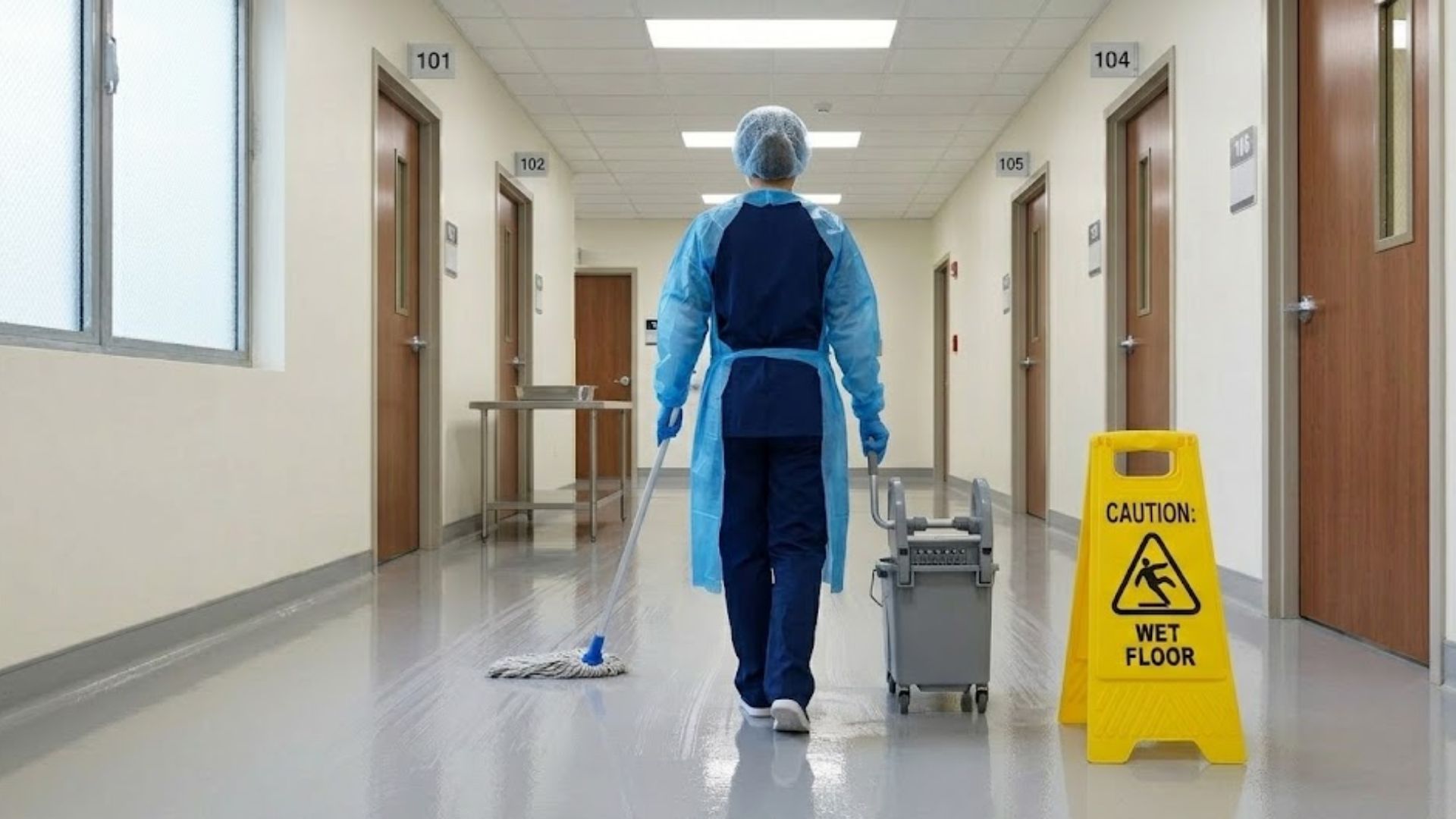
Terminal Clean vs Discharge Clean vs Isolation Discharge — Three Levels, Three Standards
The terminology used by different facilities for post-patient room cleaning is inconsistent — "discharge clean", "terminal clean" and "checkout clean" are all used, sometimes interchangeably, sometimes to mean different things. The level of cleaning required is determined not by what the room is called, but by the infection risk of the patient who occupied it and the condition of the space. Understanding the distinction between a standard discharge clean and an isolation terminal clean is essential to ensuring the correct protocol is applied — and that your next patient is not placed in a room that received an insufficient standard of cleaning for its risk level.
Applied after discharge of a patient with no known infectious condition, no transmission-based precautions, and no reported clinical incidents during their stay. The room is thoroughly cleaned and disinfected to bring all surfaces back to a baseline clinically safe state before the next patient.
Scope: All horizontal and vertical surfaces — bed frame, rails and mattress surround, bedside table, call button, over-bed table, all chairs and seating, all equipment surfaces, window sill, door handle (both faces), light switches. Bathroom: full sanitisation — toilet, sink, tap handles, mirror, soap and paper towel dispensers, floor. Privacy curtains visually inspected for soiling — changed if soiled.
Chemistry: TGA-registered hospital-grade disinfectant (QAC or equivalent) at correct dilution with observed dwell time. Two-step protocol: clean first with neutral detergent, then disinfect.
Applied after discharge or transfer of a patient on transmission-based precautions — contact, droplet or airborne precautions — or after a patient with a confirmed or suspected infectious condition. This is the most thorough and time-intensive room cleaning event in a healthcare facility.
Scope: Everything in Level 1, plus: all curtain tracks and curtain rails (not just the curtain fabric), ceiling vent covers and surfaces above the sightline, all medical equipment that remained in the room, all waste container exteriors, the room door interior and frame, the floor drain surround, and all items left in the room by the previous patient.
Chemistry: Sporicidal TGA-registered product for C. diff, norovirus and enteric pathogen discharge. Sodium hypochlorite solution or hydrogen peroxide-based sporicidal product at correct concentration and dwell time — not QAC alone. QAC is used as the cleaning chemistry in Step 1; sporicidal is applied in Step 2 for the disinfection phase.
Every Surface a Terminal Clean Must Cover — and Why Each One Matters
The most common failure mode in post-patient room cleaning is incomplete surface coverage — areas that are missed not because they are forgotten in principle, but because they are physically difficult to access or are not visually prominent. High-touch surfaces at arm height get cleaned first and most thoroughly. Low surfaces, the underside of bed rails, the rear face of door handles, the inside of curtain tracks, and the areas beneath and behind fixed equipment are consistently under-cleaned in facilities that do not use a structured checklist-based completion system.
NSQHS Standard 3 does not specify a surface checklist — it requires that facilities demonstrate their cleaning processes are adequate to prevent cross-contamination between patients. The practical translation of that requirement is a structured room cleaning sequence that covers every surface with a documented completion record. Our terminal clean checklist covers 47 surface categories across the room, bathroom and equipment zones. The checklist is signed off by the cleaner and countersigned by the supervisor, and a copy is retained for your infection prevention file.
Privacy curtains deserve specific attention. Curtain fabric is one of the most heavily contaminated surfaces in a shared patient room — studies have found that curtains are touched by staff 30–40 times per day and are rarely changed at discharge unless visibly soiled. Our terminal clean protocol includes visual inspection of all privacy curtain fabric at every discharge, mandatory change at every isolation discharge, and scheduled change at regular intervals for all other rooms. Curtain tracks and rails are wiped and disinfected regardless of whether the curtain is changed. See our full services overview or request a quote.
What's Covered in Every Terminal Clean
How We Execute a Terminal Clean — Sequence, Chemistry & Sign-Off
The sequence of a terminal clean is as important as its completeness. Cleaning a surface after an adjacent surface has already been disinfected contaminates the disinfected surface. The correct sequence — top-down, far-to-near, room before bathroom, all horizontal surfaces before the floor — ensures that each surface that has been cleaned and disinfected is not recontaminated by the cleaning of a surface worked on later.
Our terminal clean protocol follows a structured 47-point room checklist that covers every surface category in the room and bathroom. The checklist is worked through in sequence — the cleaner cannot sign off a zone until every item in that zone is completed. The checklist is not optional or advisory; it is the completion record for the room and is countersigned by a supervisor before the room is released. A copy is retained in your facility's infection prevention documentation file.
For isolation discharges, the protocol adds PPE donning before entry (gown, gloves, mask, eye protection as appropriate to the transmission category), use of sporicidal chemistry in Step 2 of the disinfection phase, disposal of all single-use cleaning equipment as clinical waste before leaving the room, PPE doffing in the correct sequence outside the room, and immediate hand hygiene after doffing. The room remains under isolation signage until the supervisor countersigns the checklist — it does not revert to a general room status when the patient leaves.
Bed availability pressure — the operational reality that discharged beds need to be turned around quickly for the next admission — is the most common driver of substandard terminal cleans in acute facilities. Our team understands the 2-hour target and is trained to achieve thorough completion within that window. We do not abbreviate the checklist to meet a bed target. If additional time is required due to room condition, the facility manager is notified before work begins.
Terminal Clean Sequence
Discharge notified to cleaning team. Risk level confirmed — standard discharge or isolation. Product set selected: QAC for standard, sporicidal for isolation. PPE level confirmed. Team mobilised with target 2-hour completion window.
PPE donned per risk level before entry. All patient belongings confirmed removed. Clinical waste emptied and replaced with fresh liner. Linen removed and bagged for laundry. Room assessed — any items requiring special handling noted before cleaning begins.
Neutral detergent applied to all surfaces in the correct sequence: ceiling-height items first (light fittings, vent covers if isolation), then shoulder-height, then waist-height, then near-floor. Far end of room first, working toward the door. Single-use colour-coded cloth per zone.
TGA-registered disinfectant (or sporicidal for isolation) applied to all cleaned surfaces in the same top-down, far-to-near sequence. Dwell time strictly observed per product label before any surface is wiped. High-touch points — bed rails, call button, door handles, tap handles — individually attended with fresh applicator.
Bathroom completed after the main room is finished. All surfaces cleaned then disinfected in sequence. Dedicated bathroom mop head used for floor. Soap, paper towel and hand sanitiser restocked. Bathroom door handle and light switch included.
47-point checklist completed and signed by cleaner. Supervisor walkthroughs and countersigns. For isolation discharges: PPE doffed outside the room in correct sequence, all single-use equipment disposed as clinical waste. Room status updated — cleared for next admission.
Standards Governing Terminal Cleaning in Australian Healthcare
Terminal cleaning in Australian healthcare facilities sits at the intersection of multiple regulatory and accreditation frameworks. Our protocol is built to satisfy each of them operationally — not as a documentation exercise.
Terminal Clean Completion Targets — By Facility Type & Room Category
| Room Type | Discharge Category | Target Completion | Protocol Level |
|---|---|---|---|
| Standard patient room | Routine discharge — no infectious risk | Within 2 hours | Standard QAC two-step |
| Standard patient room | Isolation discharge — contact precautions | Within 2 hours | Sporicidal two-step + PPE + single-use equipment |
| Day procedure bay | Post-procedure turnaround | Within 45 minutes | Standard QAC two-step |
| Consulting / treatment room | End-of-session clean | Within 30 minutes | Standard QAC two-step |
| Aged care resident room | Discharge or transfer — standard | Within 4 hours | Standard QAC two-step |
| Aged care resident room | Discharge or transfer — isolation | Within 4 hours | Sporicidal two-step + full PPE protocol |
← Swipe to see full table on mobile | Completion times are targets from discharge notification — subject to room condition and availability of clean team
Terminal Cleaning Cost in Melbourne
Terminal cleaning is priced per room or bay, based on the room size, the discharge category (standard or isolation), whether sporicidal chemistry and PPE disposal are required, and the turnaround time target. Isolation terminal cleans take longer, use higher-specification products and involve clinical waste disposal — they are priced accordingly.
For facilities requiring a standing arrangement — where terminal cleans are called on within a defined response window on an ongoing basis — we provide a service agreement with a confirmed response time, a per-room pricing schedule and a monthly billing cycle. This removes the need for a new quote with each discharge event and ensures your cleaning team is already familiar with the facility layout and room configurations.
Written quotes for individual terminal clean engagements are provided within 24 hours. See our pricing page or request a quote online.
Terminal Clean Cost Guide
Terminal Cleaning & Discharge Cleans — Frequently Asked Questions
Common questions from Melbourne healthcare and aged care facility managers about post-patient room terminal cleaning.
A routine daily clean maintains an occupied room at a baseline safe level — high-touch surfaces wiped, bathroom cleaned, floor mopped. A terminal clean is the comprehensive reset of an entire room after a patient has vacated — every surface, every zone, every piece of equipment, the bathroom in full, curtains inspected or changed, and all surfaces cleaned then disinfected using the two-step protocol. A terminal clean takes significantly longer than a daily clean because it covers the entire room to a complete standard, not just the highest-frequency surfaces. It is performed at every patient discharge or transfer, before the room is reoccupied.
Standard quaternary ammonium compound (QAC) disinfectants are not effective against bacterial spores — the dormant, resilient form of certain organisms including C. diff. C. diff spores can survive on environmental surfaces for months and are resistant to standard hospital-grade disinfectants. If a QAC is used as the sole disinfectant in a terminal clean following discharge of a C. diff patient, viable spores remain on surfaces and are capable of infecting the next patient. A TGA-registered sporicidal product — typically sodium hypochlorite or hydrogen peroxide-based — at the correct concentration and dwell time is required to inactivate spores. The same sporicidal requirement applies to norovirus isolation discharges, as norovirus is also resistant to QAC-only disinfection at standard concentrations.
A standard discharge terminal clean for a single patient room with ensuite is achievable within 2 hours with a trained cleaner working to a structured checklist. An isolation discharge terminal clean — which adds sporicidal chemistry with required dwell times, full PPE, and single-use equipment disposal — typically takes 2.5–3.5 hours for a standard-sized room. Day procedure bay turnarounds, which are smaller scope, target 45 minutes. The 2-hour target for standard rooms is our standard commitment from discharge notification. If a room's condition — heavy soiling, isolation category, or extended linen and equipment removal — requires additional time, the facility manager is notified before cleaning begins so bed availability can be managed accordingly.
Privacy curtain fabric is changed at every isolation discharge and whenever visually soiled at any discharge. For standard (non-isolation) discharges, curtain fabric is visually inspected at every terminal clean — if there is any visible soiling, staining or contamination, it is changed. If visually clean, it is assessed against the facility's scheduled curtain change interval. Curtain tracks and rails are wiped and disinfected at every terminal clean regardless of whether the curtain fabric is changed — the track and rail surfaces are touched by staff 20–40 times per day during curtain use and are frequently overlooked in post-patient cleans. Our protocol treats track and rail as a mandatory cleaning item in every terminal clean.
Standard discharge terminal clean for a single patient room with ensuite: $160–$280 per room. Isolation discharge terminal clean with sporicidal protocol, PPE and clinical waste disposal: $280–$480 per room. Day procedure bay turnaround: $80–$160 per bay. Aged care resident room post-discharge: $180–$320 per room. Facilities requiring an ongoing standing arrangement with confirmed response times can arrange a service agreement with a per-room rate and monthly billing. See our pricing page or request a quote online.
Get a Terminal Cleaning Quote for Your Melbourne Healthcare Facility
NSQHS Standard 3 aligned 47-point checklist, sporicidal isolation protocol, TGA-registered chemistry and signed completion records for every room. Standing service arrangements with confirmed response times available. Call 0484 042 336 or request a quote online.